
Puzzle Feeders for Fast Eaters: Do They Really Work?

Last Updated: October 23, 2026
Quick Summary
Yes, puzzle feeders fast eaters by making dogs and cats work to access each piece of food, slowing mealtime from 30 seconds to 10-15 minutes and reducing bloating, overeating, and digestive upset while providing mental enrichment.
- A dog normally finishing in 30 seconds might spend 10-15 minutes with a puzzle feeder, giving the digestive system time to catch up.
- Puzzle feeders reduce boredom and anxiety by keeping pets mentally engaged during mealtime and occupying them during stressful times.
- Introduce puzzle feeders gradually over 1-2 weeks, starting with empty exploration, then easy wins, partial meals, and full meals to prevent frustration.
- Measure results after one week by comparing meal duration, food intake, pace signs like gulping or vomiting, and post-meal behavior.
- Puzzle feeders work best for healthy, food-motivated dogs but may not suit senior dogs with dental problems or pets with medical eating conditions.
Table of Contents
- How Puzzle Feeders Slow Fast Eating
- Benefits of Puzzle Feeders for Dogs
- Slow Feeder vs Puzzle Feeder for Dogs: What's the Difference?
- Best Slow Feeder Bowls for Dogs and When to Use Them
- How to Slow Down a Dog Eating Too Fast
- Choosing and Introducing a Puzzle Feeder: Safety and Suitability
- Are Puzzle Feeders Right for Your Pet?
- Frequently Asked Questions
How Puzzle Feeders Slow Fast Eating
Puzzle feeders fast eaters by making dogs and cats work for their food. Instead of gobbling kibble from a bowl, your pet manipulates the feeder to access each piece, slowing them down, engaging their mind, and extending mealtime.
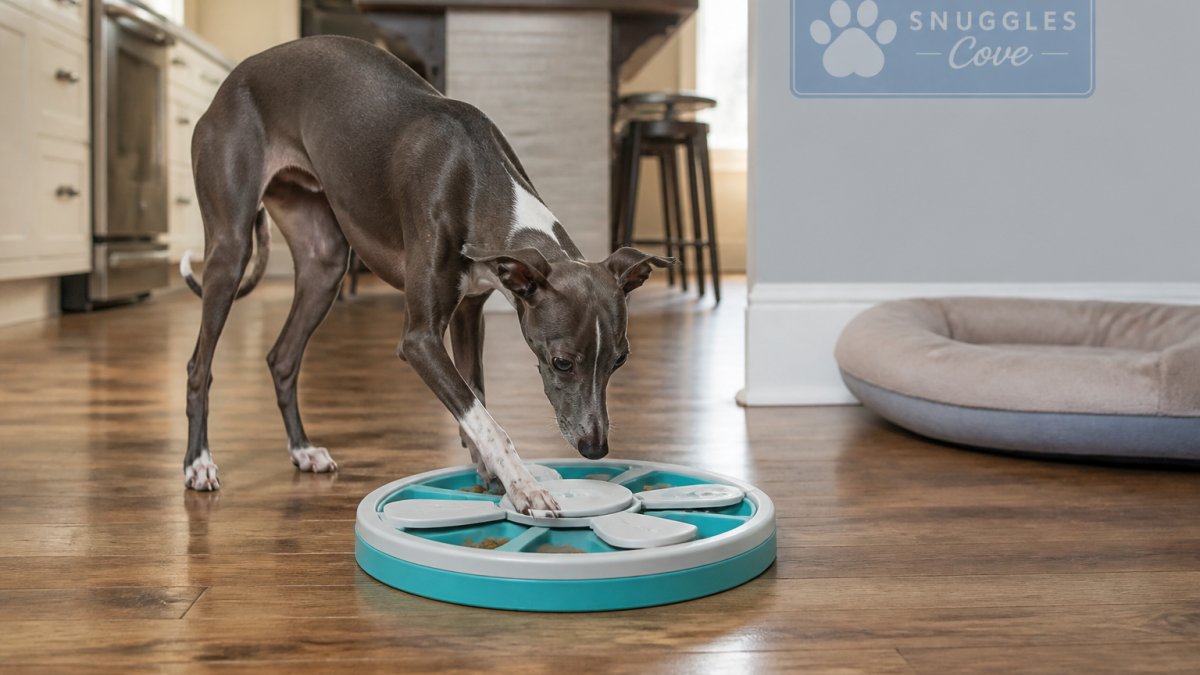
Your pet nudges, paws, or rolls the feeder to reveal small portions.
Feeders use different mechanisms, sliding compartments, spinning wheels, treat-dispensing balls, so you can match difficulty to your pet's intelligence and motivation.
Benefits of Puzzle Feeders for Dogs
Slower eating is the obvious benefit, but a dog that works for food also gets enrichment: their brain stays active, and they feel satisfied by the effort, not just the food.
Dogs prone to overeating often struggle with bloating, gas, or digestive upset. Slower eating lets the body process food gradually, and your pet feels fuller on less food, aiding weight management.
Puzzle feeders also reduce boredom: a dog left alone with one stays occupied and is less likely to develop destructive behaviors from understimulation. Many owners report anxious dogs calm down with a puzzle feeder during stressful times.
The enrichment benefit extends to senior dogs and those recovering from surgery. A slower mealtime keeps them mentally engaged without requiring physical activity they may not tolerate.
| Benefit | Impact | Best For |
|---|---|---|
| Slower eating pace | Reduces bloating and digestive upset | Fast eaters and dogs prone to gas |
| Mental enrichment | Keeps brain active, reduces boredom | Anxious or under-stimulated dogs |
| Portion control | Helps with weight management | Dogs that overeat |
| Behavioral calm | Occupies anxious dogs during stressful times | Dogs with separation anxiety |
Slow Feeder vs Puzzle Feeder for Dogs: What's the Difference?
These terms are often confused.
A puzzle feeder is a toy you fill with food that your dog must manipulate to dispense kibble or treats, requiring more active problem-solving and engagement.
Slow feeders suit dogs that just need to slow their pace.
Slow feeders are easier to clean and refill; puzzle feeders take more time but offer richer enrichment. Many owners alternate by meal or by day.
Best Slow Feeder Bowls for Dogs and When to Use Them
Slow-feeder bowls come in stainless steel and ceramic (durable, easy to clean) or plastic (cheaper, wears faster). Look for a non-slip base so the bowl doesn't slide during eating.
The ridge pattern matters: simple bumps are easier to clean, while true maze designs slow eating more effectively but are harder to clean.
Use a slow-feeder bowl for a quick, no-fuss solution. They work well for:
- Dogs that eat quickly but aren't anxious or bored
- Busy owners who want a no-fuss option
- Multi-dog households where you need to supervise easily
If your dog finishes a slow feeder in under five minutes, they likely need puzzle feeders fast eaters instead. Slow feeders are a starting point, not a complete solution for highly motivated fast eaters.
How to Slow Down a Dog Eating Too Fast
Most advice stops at "use a puzzle feeder", a tool, not a plan. Measure the problem first, then introduce the feeder with a baseline and follow-up so you can tell whether it works.
Step 1: Establish a baseline before you change anything
For three normal meals, time how long your dog takes to finish from their current bowl, and record:
- Food intake: Did they finish everything, leave some, or ask for more?
- Pace signs: Gulping, gasping, vomiting shortly after eating, or immediately looking for more food.
- Behavior after eating: Restless, anxious, or settled?
A dog consistently finishing under one minute has a clear fast-eating baseline. If they finish in two to three minutes but show gas or vomiting, the pace may still be too fast. Write the baseline down to compare later.
Step 2: Choose the right tool for the cause
Fast eating has different drivers, and the tool should match:
- Simple speed (no anxiety, no competition): A slow-feeder bowl or an easy puzzle feeder is enough. The goal is to stretch mealtime, not to add frustration.
- Boredom or under-stimulation: A puzzle feeder that requires problem-solving adds enrichment alongside pacing.
- Anxiety or food scarcity history: Introduce the feeder empty first, reward investigation, and keep sessions short. A puzzle feeder can help, but it does not replace behavioral work for anxiety.
Step 3: Introduce the feeder with a gradual plan
Do not swap the bowl for a hard puzzle on day one. Use this sequence:
- Empty exploration (1-2 days): Place the feeder on the floor with no food. Let your dog sniff, paw, and investigate. Praise any interaction.
- Easy win (2-3 days): Add a few pieces of kibble to the easiest compartment. The dog should succeed within a minute or two.
- Partial meal (3-5 days): Put half the meal in the puzzle feeder and half in the regular bowl to prevent frustration from turning into a skipped meal.
- Full meal (ongoing): Once your dog reliably works the feeder, use it for one meal per day.
- Increase difficulty slowly: Move to a harder configuration only after your dog finishes the current level in under five minutes without frustration.
Step 4: Measure whether eating actually slowed
After one week, repeat the baseline measurement. Compare:
- Meal duration: A jump from 30 seconds to 5-10 minutes is meaningful; 20 minutes may be too hard if the dog is frustrated.
- Food intake: If they leave food behind, the feeder may be too difficult or the portion too large.
- Pace signs: Reduced gas, gulping, or post-meal vomiting matter more than the clock.
If eating has not slowed after a week, the feeder is likely too easy. If the dog is frustrated or refusing food, it is too hard. Adjust one variable at a time.
Troubleshooting the three common failure modes
Frustration: The dog paws, whines, or walks away.
Refusal: The dog ignores the feeder. Check that the food is motivating (try a higher-value kibble or a small treat mixed in), and start with the feeder empty or barely loaded.
Solving too quickly: The dog finishes in under two minutes. Use smaller openings, multiple steps, or a frozen insert, and rotate between two or three feeders so the dog cannot memorize one pattern.
Choosing and Introducing a Puzzle Feeder: Safety and Suitability
The right puzzle feeder depends on your pet's age, size, health, food type, and chewing style, plus whether you can supervise mealtime. Here's how to match the feeder to your pet, plus the safety and hygiene details that are easy to overlook.
What puzzle feeders can and cannot do
Puzzle feeders are a pacing and enrichment tool: they make a fast eater work for food, extend mealtime, and add mental stimulation. They are not a treatment for medical conditions.
- They can help with: slowing eating pace, reducing gulping, adding enrichment, and occupying a bored or anxious pet during mealtime.
- They cannot prevent or treat: bloat (gastric dilatation-volvulus), food guarding, separation anxiety, or underlying gastrointestinal disease. If your dog gulps and then vomits, has a history of bloat, or shows pain around eating, talk to your veterinarian before relying on a feeder.
- They are not a portion-control substitute: fill the feeder with the same amount of food your pet normally eats. A puzzle feeder stretches the meal; it does not reduce the ration unless you intentionally measure less.
Owners often expect a puzzle feeder to fix overeating. It can slow the pace, but weight management still depends on total calories and veterinary guidance.
Matching the feeder to your pet
Puppies: Under about six months, many lack the focus and jaw control for complex puzzles. Choose large, simple compartments, supervise closely, and avoid small pieces that can be chewed off and swallowed.
Senior dogs: Arthritis, dental disease, and reduced vision can make hard puzzles frustrating.
Small dogs and cats: A feeder designed for a large dog may be too big for a cat or small dog.
Large dogs and strong chewers: Durability is the priority.
Pets with medical needs: If your pet has a condition affecting eating, swallowing, or mobility, ask your veterinarian whether a puzzle feeder is appropriate.
Food type and feeder suitability
Not every feeder works with every food:
- Kibble: The most versatile. Most puzzle feeders are designed for dry food. Match kibble size to the feeder openings; too-large kibble jams, too-small kibble falls out too easily.
- Wet food: Many puzzle feeders are not designed for wet food because it smears and is hard to clean. Some feeders have removable inserts or freezer-friendly designs for wet food or broth.
- Treats and frozen inserts: Good for enrichment and for dogs that solve dry-food puzzles too quickly. Frozen inserts extend mealtime but require freezer space and thawing time.
Safety and supervision
Supervise mealtime, especially with a new feeder. Watch for:
- Chewing on the feeder itself: If your pet tries to chew the plastic or fabric, remove the feeder and choose a sturdier option.
- Choking or swallowing pieces: Inspect the feeder regularly for cracks, loose parts, or worn edges.
- Frustration that escalates: Pawing, barking, or frantic behavior is a sign the feeder is too hard. Go easier.
Cleaning and hygiene
Puzzle feeders have crevices, so they need more cleaning than a bowl. Rinse after each use, wash with warm soapy water per the manufacturer's instructions, and dry fully before refilling. Feeders used with wet food or frozen inserts need more frequent deep cleaning; check compartments for residue, as old food can harbor bacteria.
Multi-pet households
In multi-pet homes, separate feeding spaces are essential. Each pet should have their own feeder and a quiet place to eat. A fast eater may still gulp if they fear another pet will take their food, so the puzzle feeder alone will not solve competition. Feed pets in separate rooms or use a gate if needed.
Are Puzzle Feeders Right for Your Pet?
Puzzle feeders work best for dogs and cats that eat too fast, experience boredom, or show anxiety around food, and less well for pets with no eating issues or low food motivation. Young, healthy, medium-to-large dogs with strong food drive are ideal; senior dogs with dental problems may struggle, while anxious dogs benefit from the mental engagement.
Cost varies. Slow-feeder bowls start cheap. Puzzle feeders range from budget-friendly to premium. At SNUGGLES Cove, we designed the PUPSICLE, a reusable enrichment toy that keeps dogs engaged with long-lasting frozen treats, offering the enrichment benefits without the complexity of traditional puzzle feeders.
Start with one feeder and observe. Does your pet enjoy it? Does their eating pace actually slow? Does the enrichment reduce anxiety or boredom? These real-world results matter more than any promise on the package.
Frequently Asked Questions
Are puzzle feeders worth it for fast eaters?
Yes, puzzle feeders can be worthwhile for fast eaters because they physically slow food consumption by requiring dogs to work through obstacles to access kibble. This extends mealtime duration, reduces bloating risk, and adds mental stimulation. However, they work best when paired with supervision and when your dog finds the challenge engaging rather than frustrating.
What's the difference between a slow feeder and a puzzle feeder for dogs?
A slow-feeder bowl uses raised ridges or compartments to physically block quick access to food without requiring problem-solving. A puzzle feeder requires the dog to manipulate parts, flip compartments, or push obstacles to earn kibble. Slow feeders are simpler and faster to use; puzzle feeders add cognitive enrichment but take longer to complete.
How do I know if a puzzle feeder is safe for my dog?
Choose feeders made from durable, food-safe materials that won't splinter or break apart. Ensure no small removable parts can be swallowed. Start with easy difficulty levels and supervise initial use. If your dog shows signs of frustration, anxiety, or attempts to destroy the feeder, it may not be the right fit. Always check that the feeder is appropriately sized for your pet.
How do I slow down a dog eating too fast?
Start with a slow-feeder bowl as the simplest option, then progress to puzzle feeders if your dog masters them easily. Feed smaller portions more frequently throughout the day, hand-feed occasionally to control pace, or use interactive toys that dispense kibble gradually. Supervise meals and ensure your dog isn't competing with other pets for food, which intensifies gulping.
Puzzle feeders work for most fast eaters, but they're not a one-size-fits-all solution. The best approach combines the right feeder with patience during introduction and honest observation of whether it actually helps your pet. If your dog is anxious, bored, or overeating, a puzzle feeder or slow-feeder bowl can make a real difference in their daily comfort and behavior. Start simple, introduce gradually, and adjust based on what you see. Your pet will tell you whether it's working.

