
How to Help Senior Dog Stand Up: A Complete Guide

Table of Contents
- Why Your Senior Dog Struggles to Stand Up
- Step-by-Step: How to Help Your Senior Dog Stand Up
- Choosing the Best Dog Bed for Joint Pain
- Senior Dog Hind Leg Weakness Exercises
- Using a Dog Mobility Harness for Senior Dogs
- Environmental Modifications for Easier Mobility
- Conclusion
- Frequently Asked Questions
Last Updated: October 9, 2026
Why Your Senior Dog Struggles to Stand Up
Watching your old friend hesitate on the floor is hard. A senior dog who once jumped onto the couch may now pause, shift, and need a few tries to get up.
The good news: most senior dogs can be helped.
Standing up is a complex move. It needs strong hind legs, good balance, and stable footing. When any of those fade, your dog needs support.
Common Causes of Hind Leg Weakness
Hind leg weakness in senior dogs usually comes from one of a few sources. Arthritis wears down the joints. Muscle atrophy weakens the back legs.
You may notice gait abnormalities, wobbling, or a slow, stiff rise. Some dogs show balance issues on smooth floors. Others struggle only after a long nap.
A common mistake is assuming it is "just old age." That label hides treatable problems.
When to See a Veterinarian
Call your vet if your dog cannot stand at all, cries out, or drags a limb. Sudden collapse is always an emergency.
Book a routine visit for slow, gradual weakness. A veterinary examination can rule out pain, nerve damage, or injury. Early care often slows the decline.
Step-by-Step: How to Help Your Senior Dog Stand Up
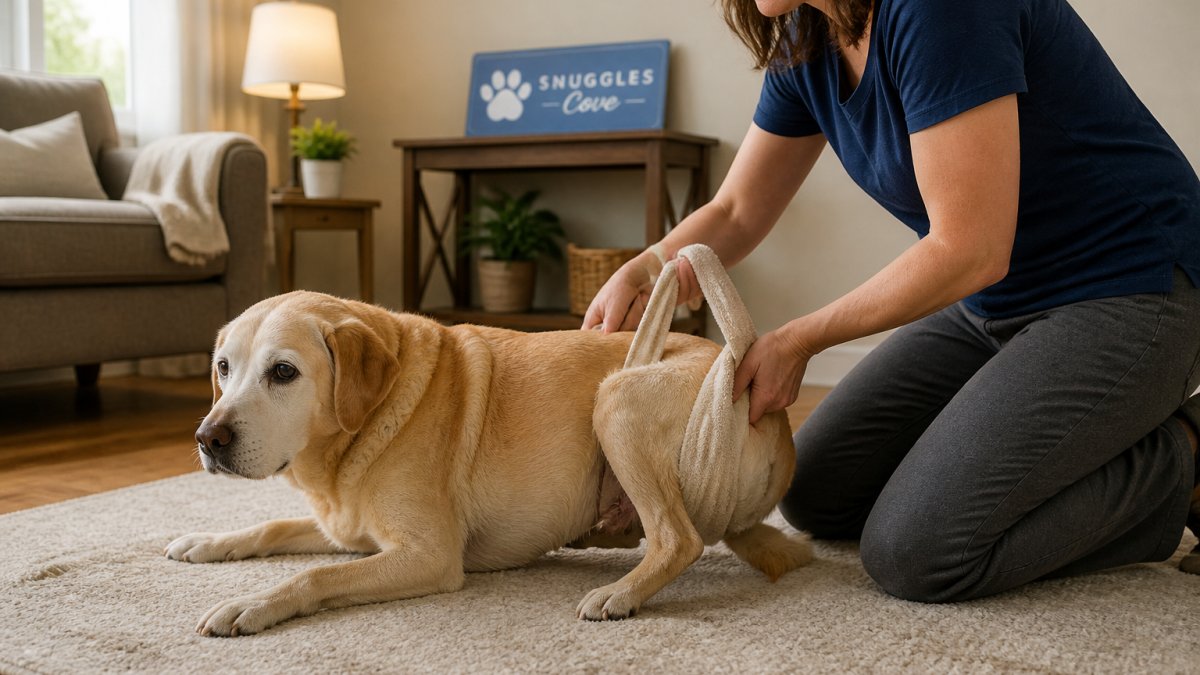
How to help senior dog stand up: support the chest and hindquarters together, keep the floor steady, and let your dog move at their own pace. Never rush the rise.
The Standard Two-Arm Lift (For Dogs Under 50 lbs)
Here is a method to consider:
- Clear the area. Remove toys and rugs that can slide.
- Crouch beside your dog. Stay calm and quiet. Position yourself at your dog's side, facing the same direction.
- Slide one arm under the chest. Support the front. Your forearm should be under the sternum, not the throat.
- Slide the other arm under the belly or hind legs. Support the back. For hind leg support, place your forearm just in front of the rear legs.
- Lift gently with your legs, not your back. Keep your dog level. Do not twist your torso.
- Hold until your dog finds footing. Then slowly release. Stay close in case they wobble.
- Praise and pause. Let your dog settle before walking.
Expected result: your dog stands with less strain and less fear.
The Towel Sling Method (For Dogs Over 50 lbs or With Severe Weakness)
For a dog who is too heavy to lift or who has severe hind leg weakness, a towel sling is safer for both of you.
DIY emergency sling:
- Use a bath towel or a sturdy scarf at least 4 feet long.
- Fold it lengthwise to create a 4-6 inch wide band.
- Slide the band under your dog's belly, just in front of the hind legs.
Pro tip: Keep a dedicated towel sling near your dog's bed for middle-of-the-night emergencies.
Condition-Specific Modifications
Different conditions require different techniques:
- Arthritis: Support the hindquarters but let your dog set the pace. Warm compresses before standing can ease stiffness.
- IVDD (intervertebral disc disease): Avoid any twisting or bending of the spine. Use a flat, firm surface and support the entire body length. A sling under the belly is safer than lifting under the chest.
- Degenerative myelopathy: Your dog may have good front leg strength but weak rear. A rear-lifting harness lets them pull themselves up with the front while you support the back.
Common Mistakes to Avoid
- Lifting by the front legs only. This strains the spine and hips and can turn mild weakness into a serious injury.
- Rushing the rise. Senior dogs need time to find balance. Rushing can cause a fall.
- Using a loose harness. A loose harness slides and gives no support. Measure your dog's girth before buying.
- Ignoring pain signals. If your dog cries out, snaps, or tenses up, stop and consult your vet.
Choosing the Best Dog Bed for Joint Pain
The best dog bed for joint pain is one with firm, supportive memory foam that cushions pressure points and helps your dog rise more easily.
This is where most owners go wrong. They buy the fluffiest bed they can find. But a senior dog sinks into it and cannot push up.
Look for:
- Orthopedic memory foam that holds its shape
- A low, easy-to-step-into edge
- A non-slip bottom so the bed stays put
- Washable covers for hygiene and easy care
Our WooF Premium Plush Pet Sofa Bed has an orthopaedical supported design that supports joint health and mobility.

Senior Dog Hind Leg Weakness Exercises
Senior dog hind leg weakness exercises build strength without strain. The goal is gentle, regular movement, not a workout. Always consult your vet before starting a new exercise routine, especially if your dog has a diagnosed condition or is recovering from surgery.
🐾 WooF - Pet Sofa "Premium Plush" Bed →
The Three Pillars of Canine Rehabilitation
Most veterinary rehabilitation programs focus on three areas:
- Strengthening: Building muscle mass in the hind legs.
- Balance and proprioception: Helping your dog know where their feet are.
- Range of motion: Keeping joints flexible.
Strengthening Exercises
- Sit-to-stand: Ask your dog to stand from a sitting position, reward, repeat 3-5 times. This is the single most effective exercise for hind leg strength. For dogs who struggle, place a hand under the belly for light support.
- Weight shifting: Gently shift your dog's weight side to side while they stand. This improves balance and core strength. Start with 30 seconds, work up to 2 minutes.
- Three-leg stands: Lift one hind leg for 2-3 seconds, then the other. This forces the standing leg to bear weight. Only do this if your dog can stand steadily with support.
- Step-ups: Use a low, stable platform (2-4 inches) and ask your dog to step up with one front leg, then the other. This builds rear strength. Start with 3 repetitions per leg.
Balance and Proprioception Exercises
- Weight shifting on unstable surfaces: Place a non-slip mat or a balance disc under your dog's feet while they stand. This challenges their balance. Start with 30 seconds.
- Cavaletti rails: Set up low poles (2-4 inches high) on the ground and walk your dog slowly over them. This improves foot placement and coordination. Start with 3-5 rails.
- Figure eights: Walk your dog in a figure-eight pattern at a slow pace. This improves turning and weight shifting.
Range of Motion Exercises
- Passive range of motion (PROM): Gently move each back leg in slow circles. Support the leg at the joint, not the paw. Do 5-10 circles per leg, once or twice daily.
- Stretching: Gently extend the hind leg backward and hold for 10-15 seconds. Never force a stretch. Stop if your dog resists.
Water Therapy
If your vet approves, swimming or underwater treadmill therapy eases joint load while building muscle. Many veterinary rehab centers offer this. For home use, a kiddie pool with warm water can work for small dogs.
Sample Weekly Schedule
| Day | Exercise | Duration |
|---|---|---|
| Monday | Sit-to-stand, weight shifting | 5 minutes |
| Tuesday | Cavaletti rails, PROM | 5 minutes |
| Wednesday | Rest | , |
| Thursday | Sit-to-stand, three-leg stands | 5 minutes |
| Friday | Figure eights, stretching | 5 minutes |
| Saturday | Water therapy (if available) | 10 minutes |
| Sunday | Rest | , |
Post-Injury Recovery Protocols
Recovery timelines vary by condition:
- IVDD (conservative management): Strict crate rest for 4-6 weeks. After that, gradual introduction of PROM and supported standing. Full recovery can take 3-6 months.
- IVDD (post-surgery): Crate rest for 4-6 weeks, then rehab exercises. Many dogs regain mobility within 8-12 weeks.
- Hip dysplasia: Ongoing management with strengthening exercises. No cure, but exercise can slow decline.
- ACL/CCL injury: Post-surgical recovery typically 8-12 weeks, with rehab starting within days.
Always follow your vet's specific instructions. These are general guidelines.
When to Stop
Stop immediately if your dog:
- Cries out or whimpers
- Tenses up or resists
- Shows increased lameness after exercise
- Seems more tired than usual
Physical Therapy with a Professional
Physical therapy with a trained rehab vet can help dogs recovering from injury or surgery. Ask your vet for a referral. A rehab vet can use techniques like laser therapy, ultrasound, and electrical stimulation that you cannot do at home.
Using a Dog Mobility Harness for Senior Dogs
A dog mobility harness for senior dogs takes the strain off your dog's back legs and off your own back.
Rear-lifting harnesses wrap under the hindquarters. You hold a handle and lift as your dog walks.
What most guides miss: fit matters more than brand. A loose harness slides and gives no support. Measure your dog's girth and weight before buying.
- Use a harness for stairs, cars, and vet visits
- Use a sling for quick help around the house
- Always support the chest and rear together
Environmental Modifications for Easier Mobility
Small changes at home make a big difference. Environmental modifications reduce slips and give your senior dog confidence.
Start with traction. Slippery floors are the number one cause of falls in older dogs. Add non-slip rugs along main walkways. Traction socks or toe grips help dogs who slide on hard floors.
Other changes to make:
- Ramps over stairs to the yard or couch
- Raised bowls so your dog eats without bending
- Orthopedic bedding in every room your dog rests
- Floor-to-door support like a runner rug to the back door
Keep water, food, and bed close together. Less walking means less strain.
Conclusion
Helping a senior dog stand up takes patience, the right technique, and a few smart tools. Start with proper lifting, add traction and a supportive bed, and keep movement gentle and regular.
That is where we come in. Pair it with our PUPSICLE enrichment toy to keep your dog happy and engaged.
Shop the SNUGGLES Cove range and give your old friend the comfort they have earned.
Frequently Asked Questions
Why is my senior dog suddenly unable to stand up?
Sudden inability to stand up can indicate a serious issue like a slipped disc, spinal injury, or neurological condition such as degenerative myelopathy. It could also be due to severe arthritis pain or muscle weakness. If your senior dog cannot stand up suddenly, contact your veterinarian immediately. They can assess for emergency conditions and recommend appropriate treatment. Early intervention often improves outcomes for many mobility issues.
Can senior dogs recover from leg weakness?
Many senior dogs can regain some mobility with proper management. Recovery depends on the underlying cause. For arthritis or mild weakness, a combination of joint supplements, physical therapy, and mobility aids like a dog mobility harness for senior dogs can significantly improve strength and stability. Conditions like degenerative myelopathy are progressive, but supportive care can maintain quality of life. Always work with your vet to create a tailored plan.
How can I help my senior dog with weak back legs?
Start by providing a supportive environment: use non-slip rugs, orthopedic bedding like the WooF Premium Plush Pet Sofa Bed, and ramps for furniture. For daily assistance, a rear-lifting harness allows you to support their hindquarters during walks and when standing up. Incorporate senior dog hind leg weakness exercises, such as gentle sit-to-stands and leg extensions, to maintain muscle tone. Consult your vet before starting any exercise routine.
When should I see a vet for my dog's mobility issues?
See a vet if your dog shows sudden weakness, drags a limb, cries out when moving, or loses bladder control. These signs may indicate a medical emergency. For gradual changes like stiffness or reluctance to climb stairs, schedule a non-urgent appointment. Early veterinary examination can identify conditions like arthritis or IVDD and guide treatment. Regular check-ups help monitor senior dog care and adjust management strategies as needed.
