
Best Orthopedic Dog Beds for Senior Dogs: 2026 Guide

Table of Contents
- What to Look For in the Best Orthopedic Dog Beds for Senior Dogs
- Memory Foam vs Egg-Crate: Which Actually Supports Aging Joints?
- Signs of Arthritis in Senior Dogs: When to Upgrade Their Bed
- Best Dog Bed for Joint Pain: Features That Make a Real Difference
- SNUGGLES Cove Pet Bed Features: What Sets It Apart for Senior Comfort
- Incontinence and Temperature Regulation: Two Senior Needs Most Beds Ignore
- How to Transition Your Senior Dog to a New Orthopedic Bed
- Common Mistakes When Buying Orthopedic Dog Beds for Senior Dogs
- Conclusion: Choosing the Right Support for Your Aging Companion
- Frequently Asked Questions
Last Updated: October 4, 2026
What to Look For in the Best Orthopedic Dog Beds for Senior Dogs
Choosing among the 5 best orthopedic beds for senior dogs comes down to three things: foam density, joint support, and how easily the cover comes off for washing.
At SNUGGLES Cove, we have spent five years refining pet beds through customer feedback, and the questions senior-dog owners ask rarely change.
Orthopedic dog beds are beds built with dense, supportive foam that distributes a dog's weight evenly instead of letting it sink into soft filling.
The American Kennel Club's guidance on senior dog care makes the point plainly: aging joints need consistent, even support, and a sagging bed works against that.
Here is what matters most before you spend anything:
- Foam density, not thickness, decides whether the bed lasts
- A removable, machine-washable cover is non-negotiable for senior dogs
- Low entry height helps dogs with mobility issues get in without a step
- A non-slip base stops the bed sliding on hard floors when your dog pushes up
Below, we break down each factor so you can judge any bed on its merits rather than its marketing.
Memory Foam vs Egg-Crate: Which Actually Supports Aging Joints?
Memory foam wins for senior dogs with joint pain. Egg-crate foam is softer and cheaper, but it compresses under body weight and loses shape within months, which is the opposite of what an arthritic hip needs.
For a dog with joint inflammation, the foam needs to hold the body level rather than let the hips drop. That is what supports spinal alignment and takes pressure off the shoulders.
When you compare beds, ask two questions:
- Does the listing state foam density or just "orthopedic foam"?
- Is the base a single supportive slab or loose shredded filling?
Shredded filling feels plush on day one and flattens by month three. A supportive base holds up far longer, and it is the single feature that separates a therapeutic bed from a cosy one.
Signs of Arthritis in Senior Dogs: When to Upgrade Their Bed
The clearest signs of arthritis in senior dogs are stiffness after rest, reluctance to climb stairs, slower rising from a lying position, and visible discomfort when touched around the hips.
Arthritis in dogs is the progressive inflammation and wear of joint cartilage, most often affecting hips, elbows, and knees. It does not reverse, but the daily environment either helps or hinders how well a dog copes.
Watch for these changes:
- Taking longer to stand up after a nap
- Hesitating before jumping onto a couch or into a car
- Shifting weight off one back leg
- Sleeping more, and choosing hard floors over a soft bed
- Grumbling or moving away when the hindquarters are handled
That last point is telling. A dog that abandons a cushioned bed for tiles is often telling you the bed is too soft to rise from. Before you assume the joints have worsened, check the bed.
Any change in mobility deserves a vet visit rather than a guess. Your vet can confirm whether the issue is arthritis, and the RSPCA's advice on senior pet health is a useful starting point for understanding what aging pets need day to day.
Best Dog Bed for Joint Pain: Features That Make a Real Difference
The best dog bed for joint pain combines high-density memory foam, a firm supportive base, a low easy-access entry, and a cover you can remove and wash. Everything else is preference.
Features that earn their place:
- High-density foam that stays level under weight
- Bolster support around the edges for dogs who like to rest their head
- Easy-access entry, meaning a low front rather than a high wall
- Water-resistant cover as a first line against accidents
- Machine-washable, removable cover for hygiene
- Non-slip base for hard flooring
Features that sound good but rarely help a senior dog: extra-thick plush that compresses, decorative fabrics that trap hair, and beds so tall your dog needs a running start.
Support for Hip Dysplasia and Mobility Issues
Hip dysplasia is a malformation of the hip joint that causes looseness, pain, and progressive arthritis. For dogs with it, weight distribution is everything. A bed that lets the rear sink forces the hips into an unnatural angle and makes every stand-up harder.
Look for a firm, flat sleeping surface rather than a deep nest. Dogs with mobility issues also benefit from a bed placed where they already rest, so they are not crossing a room to reach it. If your dog struggles on smooth floors, put a runner beside the bed too. Small changes to the path matter as much as the bed itself.
SNUGGLES Cove Pet Bed Features: What Sets It Apart for Senior Comfort
The SNUGGLES Cove bed was built around a problem other beds keep failing at: the hood.
🐾 WooF - Pet Sofa "Premium Plush" Bed →
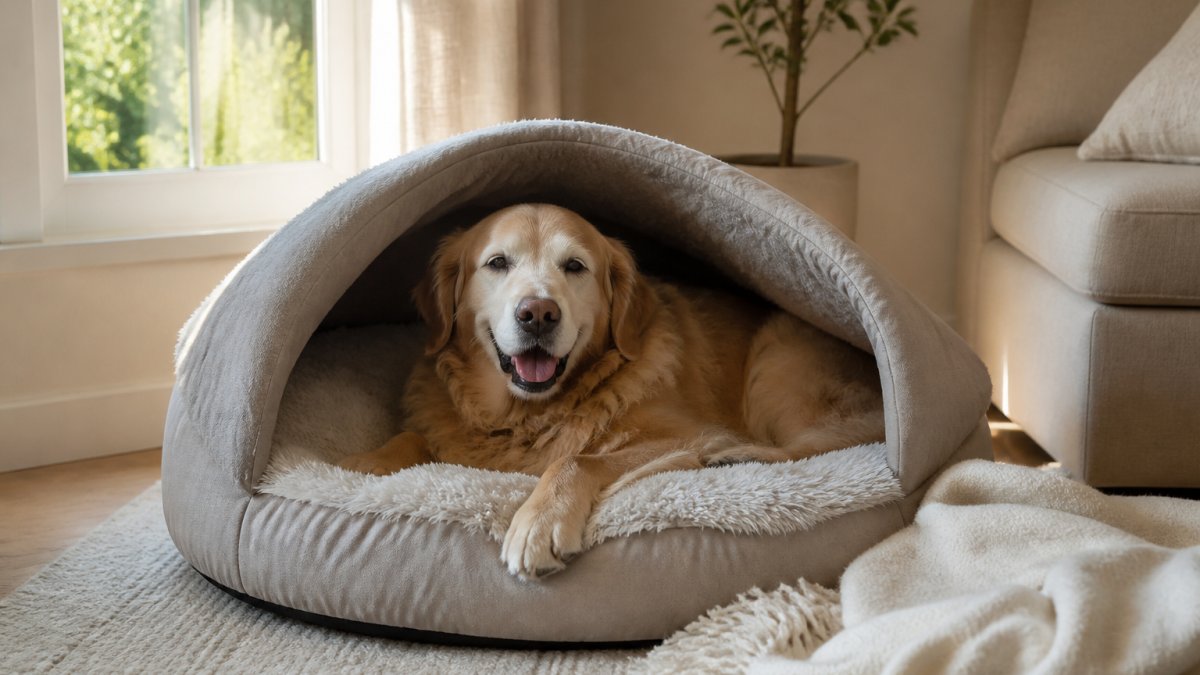
The WooF Premium Plush Pet Sofa Bed is our orthopedically supported design, built to support joint health and mobility while staying easy to live with.

What senior-dog owners tend to notice first:
- Removable, washable covers that pull off in one piece and go straight into the machine
- A non-slip base using eco-etched technology, so it stays put on tiles and timber
- A 5th-generation design, refined across five years of customer feedback
- A reinforced hood that stays open, which is the complaint we hear most about other enclosed beds
One customer put it simply: "WOW, the hood actually stays open! Every other bed we tried flopped over. This one is still looking perfect." Another said the removable covers "make washing so much easier."
If your dog needs mental engagement as well as rest, our PUPSICLE enrichment toy holds long-lasting frozen treats.
Incontinence and Temperature Regulation: Two Senior Needs Most Beds Ignore
Most orthopedic bed guides stop at foam density and never mention the two issues that actually disrupt a senior dog's sleep: accidents and overheating.
Incontinence affects many older dogs, particularly females after spaying and dogs with age-related muscle weakness. You do not need a medical bed, but you do need a water-resistant cover and a washable outer layer.
Temperature regulation is the one nobody warns you about. Senior dogs struggle more with heat and cold than young dogs. Memory foam traps body heat, which is a genuine benefit in winter and a problem in summer.
Signs your dog is too warm in bed: restlessness, shifting position repeatedly, panting at rest, or abandoning the bed for cool floorboards. If you see that in summer, move the bed rather than replace it.
How to Transition Your Senior Dog to a New Orthopedic Bed
Most senior dogs accept a new bed within a few days if you keep their familiar scent on it. Put something unwashed from their old bed inside the new one, place it in the spot they already sleep, and let them investigate without being lifted onto it.
A step-by-step approach that works:
- Put the new bed beside the old one rather than replacing it immediately
- Add a worn blanket or toy from the old bed for familiar scent
- Place a treat or their usual toy on the new bed and let them choose
- Feed them near the bed so the association is positive
- Remove the old bed once they have slept in the new one at least twice
Skip the temptation to pick your dog up and place them in it. Being lifted can be uncomfortable for a dog with sore hips, and it teaches nothing. Patience beats persuasion here.
If your dog refuses the new bed for more than a week, check the firmness. A bed that is too soft is genuinely uncomfortable for an arthritic dog to rise from, and they will tell you by choosing the floor.
Common Mistakes When Buying Orthopedic Dog Beds for Senior Dogs
The most expensive mistake is buying on thickness alone. A 15cm bed of low-density foam supports less than a 7cm bed of high-density foam, and it will flatten far sooner.
Other mistakes we see repeatedly:
- Ignoring the cover. A bed with a fixed cover becomes unusable the first time there is an accident.
- Buying too small. Senior dogs need room to stretch out without their joints being bent. Measure your dog nose to tail while lying down, then add margin.
- Skipping the non-slip base. On tiles and timber, a sliding bed makes standing up harder and can cause a fall.
- Assuming "orthopedic" is regulated. It is a marketing term. Check the foam description and the stated density instead.
- Replacing the bed but not the location. If the old spot was draughty or in full sun, the new bed inherits the problem.
Here is the quick version to compare against any bed you are considering:
| What to Check | Why It Matters | Red Flag |
|---|---|---|
| Foam type and density | Decides joint support and lifespan | "Orthopedic foam" with no detail |
| Cover | Hygiene and incontinence management | Fixed, non-removable cover |
| Entry height | Easy access for stiff joints | High walls all round |
| Base grip | Prevents sliding and falls | Smooth underside |
| Size | Room to stretch out flat | Bed barely longer than the dog |
| Bolster support | Head and neck comfort | Collapses after a few weeks |
Conclusion: Choosing the Right Support for Your Aging Companion
A senior dog's comfort comes down to support that holds its shape, a cover you can wash without a fight, and a bed placed where they actually want to sleep. Get those right and you will notice the difference in how easily they rise each morning.
At SNUGGLES Cove, we built our bed around exactly those priorities: a reinforced plush hood that stays open, removable and machine-washable covers, and a non-slip base that keeps the bed steady on hard floors. It is available in M through XXL, so large breeds get a bed that genuinely fits.
Shop the SNUGGLES Cove range and give your aging companion the support they have earned.
Frequently Asked Questions
What is the best orthopedic bed for an elderly dog?
The best bed depends on your dog's size and mobility. Look for high-density memory foam that supports joints without sinking, a low easy-access entry, and a removable, machine-washable cover. For senior dogs with arthritis, a bed with a non-slip base and bolstered edges helps them feel secure when getting in and out. The SNUGGLES Cove Premium Plush Sofa Bed offers orthopedic support and a non-slip bottom, making it a strong option for aging pets.
What type of bed is best for a senior dog with arthritis?
A memory foam bed with a firm supportive base is ideal for arthritic dogs. It distributes weight evenly and reduces pressure on inflamed joints. Avoid egg-crate foam, which compresses quickly and offers little therapeutic support. Also consider a bed with a low entry point so your dog doesn't have to climb or jump. Water-resistant covers are a bonus for accidents. The best dog bed for joint pain combines these features with easy cleaning.
How do I know if my senior dog needs an orthopedic bed?
Watch for signs of arthritis in senior dogs: stiffness after naps, reluctance to climb stairs, limping, or difficulty lying down. If your dog takes longer to settle or shifts frequently, they may be uncomfortable on a standard bed. An orthopedic bed provides pressure relief and joint support. If you notice these changes, upgrading to a therapeutic bed can improve their comfort and sleep quality.
Are orthopedic beds worth the higher price for older dogs?
Yes, if your dog shows signs of joint pain or mobility issues. Orthopedic beds use high-density foam that maintains its shape and supports aging joints, unlike cheap fillers that flatten. This can reduce morning stiffness and improve sleep. While they cost more upfront, the durability and health benefits often justify the investment. Look for removable covers and water-resistant liners to extend the bed's life.
