
Best Dog Bed for Joint Pain: 2026 Guide

Table of Contents
- Why the Best Dog Bed for Joint Pain Matters for Senior Dogs
- Signs of Arthritis in Dogs: When to Upgrade Their Bed
- Orthopedic Dog Bed Benefits: Pressure Relief and Spine Alignment
- How to Manage Dog Joint Pain at Home with the Right Bed
- Memory Foam vs. Fiber Fill: What Actually Supports Joints
- Choosing the Best Dog Bed for Joint Pain: Features That Matter
- Frequently Asked Questions
Last Updated: September 26, 2026
Why the Best Dog Bed for Joint Pain Matters for Senior Dogs
Finding the best dog bed for joint pain is one of the most practical things you can do for an aging dog. As dogs get older, cartilage wears down, joints stiffen, and the simple act of lying down stops being simple. At SNUGGLES Cove, we've spent five years listening to pet parents describe the same problem: their senior dog circles the room at night, shifts position constantly, and wakes up stiff.
That restlessness isn't fussiness. It's discomfort.
A supportive bed changes how weight is distributed across the hips, spine and elbows. It gives an arthritic dog a surface that cushions pressure points instead of pressing back into them. For a dog with hip dysplasia or age-related joint changes, that difference shows up in how easily they rise after a nap.
Below, we'll break down the signs that your dog needs an upgrade, what actually matters in an orthopedic bed, and how to manage joint pain at home with better bedding choices.
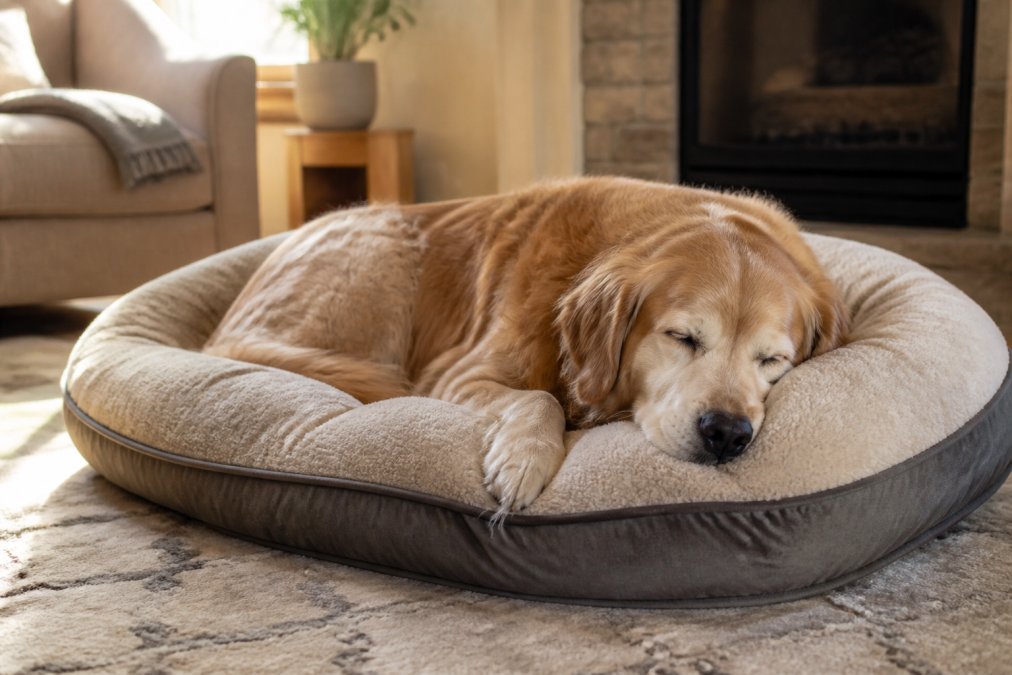
Signs of Arthritis in Dogs: When to Upgrade Their Bed
The clearest signs of arthritis in dogs are stiffness after rest, reluctance to climb stairs, and visible discomfort when lying down or standing up. If your dog takes a moment to get moving in the morning, joint pain is likely already affecting their sleep.
Watch for these signals:
- Slower to rise after naps, especially in cold weather
- Shifting position repeatedly through the night
- Hesitating on stairs, sofas or car ramps
- Licking or chewing at a specific joint
- Losing interest in walks they used to love
- Sleeping on hard floors instead of their usual spot
That last one surprises people. A dog in pain will sometimes abandon a soft bed because it offers no real support, then choose a cool hard floor where at least the surface doesn't shift under them. If your dog has stopped using their bed, that's a message, not a phase.
The American Veterinary Medical Association guidance on osteoarthritis in dogs notes that osteoarthritis is one of the most common conditions affecting older dogs, and that management usually combines weight control, appropriate exercise and environmental changes. Bedding is one of the easiest environmental changes to make.
Orthopedic Dog Bed Benefits: Pressure Relief and Spine Alignment
Orthopedic dog bed benefits come down to two things: pressure relief and spine alignment. A high-density foam base spreads a dog's body weight across a wider area, which reduces the concentrated pressure on hips, elbows and shoulders. That matters most for large breeds, where the same joint carries far more load.
Spine alignment works differently. When a bed is too soft, the middle sags and the dog's back curves into it. Over a full night, that position strains the spine and the muscles supporting it. A firmer, supportive base keeps the spine closer to neutral, which is why many owners report their dog seems to stretch out more comfortably.
How to Manage Dog Joint Pain at Home with the Right Bed
Managing dog joint pain at home starts with the sleeping surface, then extends to the room around it and the routine around that. A supportive bed is the foundation, but the way you position it, pair it with mobility aids, and manage temperature determines whether your dog actually uses it through the night.
Set up the room, not just the bed
- Place the bed away from draughts and cold floors, since cold worsens stiffness
- Add a non-slip mat underneath if your dog struggles to step up
- Keep the bed low enough that your dog can walk on rather than jump in
- Put the bed near where your dog already chooses to rest, not where you'd prefer it
- Wash bedding regularly to reduce dust and allergens that irritate joints already under stress
A common mistake is buying an oversized bed for a small arthritic dog. Too much space means no boundary to lean against, and many dogs sleep better with gentle containment. Conversely, a dog that can't stretch out will wake up cramped.
Temperature regulation: the angle most guides skip
Arthritic joints tend to stiffen in the cold, so warmth helps, but many orthopedic beds trap heat, and a dog that runs hot will avoid a bed that overheats. The trade-off is real: a thick memory foam base insulates well, which is why some arthritic dogs love it in winter and abandon it in summer. Look for breathable covers, moisture-wicking fabrics, or a cooling gel layer if your dog pants or seeks out tile floors after lying down. A practical middle path is a bed with a removable, washable cover you can swap for a lighter one in warm months, plus a breathable base layer that lets air move under the foam.
🐾 WooF - Pet Sofa "Premium Plush" Bed →
Post-surgical recovery is a different job than arthritis support
A dog recovering from orthopedic surgery, a TPLO for a cruciate tear, a hip replacement, or fracture repair, has different bedding priorities than a dog with chronic arthritis. Post-surgical dogs need a firm, stable surface they can push up from without slipping, a low entry point so they don't have to step over a high bolster, and often a flat profile rather than a nest shape, because a dog in a cone or with a shaved flank may not tolerate being enclosed. Ask your vet what positioning is safe before choosing, and expect to swap the bed again once the incision heals and the dog transitions back to chronic management.
Pair the bed with the rest of the mobility plan
A bed is one node in a broader plan. Most practitioners find that bedding works best alongside:
- Ramps or low steps for sofas and cars, so the dog isn't jumping on stiff joints
- A non-slip runner on hard flooring along the dog's main path through the house
- Short, frequent leash walks rather than one long one, to keep joints moving without overloading them
- Vet-prescribed physical therapy exercises, weight shifts, sit-to-stands, and controlled leash walks, done on a non-slip surface, often right next to the bed
- Weight management, since every extra pound multiplies load through the hips and elbows
If your dog is already on joint supplements, NSAIDs, or monthly injections, the bed doesn't replace any of that.
Memory Foam vs. Fiber Fill: What Actually Supports Joints
Memory foam and fiber fill are not interchangeable, and the difference shows up within weeks. Memory foam is a high-density material that moulds to the body's shape and returns to form slowly, which is what gives it pressure-relieving properties. Fiber fill is loose stuffing, similar to what you'd find in a standard cushion, and it compresses over time.
| Feature | Memory Foam | Fiber Fill |
|---|---|---|
| Pressure relief | High, moulds to joints | Low, flattens quickly |
| Spine support | Keeps spine closer to neutral | Sags in the middle |
| Durability | Holds shape for years | Compacts within months |
| Best for | Arthritis, hip dysplasia, senior dogs | Young, light dogs with no joint issues |
| Maintenance | Spot clean, removable cover | Frequent re-fluffing needed |
Choosing the Best Dog Bed for Joint Pain: Features That Matter
The best dog bed for joint pain combines firm, high-density support with a cover you can actually wash and materials that won't off-gas in your home. Everything else is preference. Here's what to check before you buy.
- Foam density and thickness: A thick, high-density base holds its shape. Thin foam loses support fast. As a rough guide, look for a thick, high-density base.
- Removable, washable cover: Senior dogs have accidents. A cover you can unzip and machine wash saves the whole bed.
- Non-slip base: Prevents the bed sliding when your dog pushes up.
- Low entry height: Easier for stiff joints to step into.
- Supportive bolster or hood: Gives the spine and hips something to rest against.
- Breathable materials: Helps dogs that overheat while they sleep.
- Hypoallergenic filling: Reduces irritation for dogs with sensitive skin.
Material safety: the check most guides skip
Durability: how to tell before you buy
Size: measure stretched out, not curled up
Frequently Asked Questions
What type of bed is best for a dog with arthritis?
A memory foam bed with a thickness of at least 10 cm is the best dog bed for joint pain because it distributes weight evenly and reduces pressure on hips and elbows. Look for a bed with a removable, washable cover and a non-slip base. Beds with a reinforced hood or bolster also help arthritic dogs feel secure when they shift positions during the night.
Do orthopedic beds really help dogs with joint pain?
Yes. Orthopedic dog bed benefits include better weight distribution, which eases pressure on sore joints and supports spine alignment. A high-density foam bed keeps your dog off hard floors and reduces the stiffness that comes from sleeping on cold, unforgiving surfaces. Many owners report their senior dogs wake up more easily and move with less hesitation after switching to a supportive bed.
How do I know if my dog needs an orthopedic bed?
Watch for signs of arthritis in dogs: slowing down on walks, difficulty rising after rest, reluctance to jump, or visible stiffness in the morning. If your dog is a senior, a large breed, or has hip dysplasia, an orthopedic bed is a practical first step. You can also manage dog joint pain at home by keeping bedding thick, dry, and warm, which helps reduce inflammation and supports muscle recovery overnight.
What features should I look for in a joint pain dog bed?
Prioritize high-density memory foam for pressure relief and a removable, machine-washable cover for hygiene. Non-slip bottoms keep the bed stable on hard floors. If your dog likes to curl, a bed with a reinforced hood or raised edges provides extra security. Size-appropriate bedding matters too: your dog should be able to stretch out fully without hanging off the edge.
