
Why Do Dogs Like Cave Beds? The Denning Instinct Explained

Table of Contents
- The Denning Instinct in Dogs: Why Cave Beds Feel Like Home
- Benefits of Hooded Dog Beds: Warmth, Security, and Better Sleep
- How to Choose the Right Size Cave Bed for Your Dog or Cat
- Dog Anxiety and Sleeping Habits: How Cave Beds Help Anxious Pets
- Health-Specific Recommendations for Senior Dogs and Large Breeds
- DIY vs. Store-Bought Cave Beds: Safety and Practicality
- Seasonal Transition Guide: Using Cave Beds Year-Round
- Conclusion
- Frequently Asked Questions
Last Updated: September 27, 2026
The Denning Instinct in Dogs: Why Cave Beds Feel Like Home
Dogs gravitate to cave beds because of the denning instinct, a survival behavior inherited from wild canids that equates enclosed spaces with safety. At SNUGGLES Cove, we've watched that instinct consistently shape where pets rest.

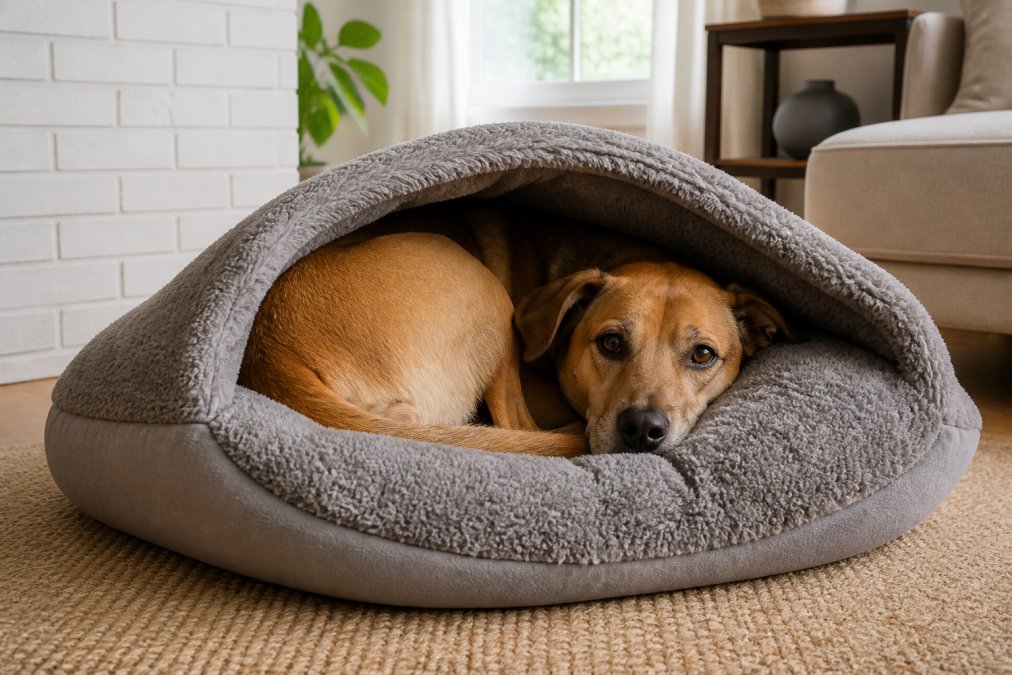
Wild canids raised pups in dens: sheltered, defensible spaces that hid them from predators and held warmth. According to the American Kennel Club's guide to dog behavior, domestic dogs retain much of that ancestral programming.
Benefits of Hooded Dog Beds: Warmth, Security, and Better Sleep
Hooded dog beds deliver three benefits at once: thermal insulation, security, and deeper sleep. The hood traps body heat while allowing airflow, which matters for older pets and short-coated breeds.
- Warmth: the hood holds heat without trapping stale air
- Security: one entry point reduces the need to stay alert
- Sleep quality: longer rest cycles and less night waking
- Calming effect: gentle pressure and enclosure help settle restless pets
How to Choose the Right Size Cave Bed for Your Dog or Cat
The right size cave bed lets your pet lie flat, stretch out, and turn around without touching the walls. Measure your dog from nose to tail base while standing, then add 15 to 20 centimetres of clearance. Too small a bed forces curling, defeating the purpose for pets with joint issues.
| Pet Type | Recommended Size | Key Consideration |
|---|---|---|
| Small dog (under 10 kg) | Medium | Enough room to stretch, not just curl |
| Medium dog (10-25 kg) | Large | Hood opening must clear the shoulders |
| Large breed (25 kg+) | XL to XXL | Full body length plus 15-20 cm |
| Single cat | Medium | Cats prefer a snug, enclosed fit |
| Two cats or large cat | Large | Room for both to settle without crowding |
Dog Anxiety and Sleeping Habits: How Cave Beds Help Anxious Pets
Cave beds help anxious pets by reducing the directions they must monitor. Separation anxiety, thunderstorm sensitivity, and general nervousness improve when a dog has a predictable, enclosed retreat, a fixed point in the house that always means the same thing: nothing happens here.
A Step-by-Step Protocol for Bed-Shy Dogs
If your dog ignores the cave bed for more than a week, run a structured introduction that builds positive association through the dog's own choices.
- Baseline observation (Days 1-2). Place the bed where your dog already relaxes and don't call the dog to it. Note whether the dog sniffs, circles, or avoids it, avoidance at this stage is normal.
- Treat scatter (Days 3-5). Toss three to five high-value treats on the bed's base while your dog watches. Walk away. The goal is for the dog to step onto the base without the hood being the focus. If your dog won't approach, move the bed closer to their current favorite resting spot.
- Hood removal (Days 6-8). Detach or fold back the hood so the bed looks like a flat mat. Repeat the treat scatter. Most dogs will lie on the base within two sessions once the enclosure is removed.
- Short hood sessions (Days 9-12). Reattach the hood but leave the opening fully expanded. Sit nearby and reward any interaction, sniffing the hood, stepping inside, lying down. Keep sessions under five minutes and end while the dog is relaxed.
- Duration building (Days 13-18). Once the dog enters voluntarily, reward longer stays: 30 seconds, then one minute, then five. Never close the hood or block the opening, the dog must always be able to leave.
Why Forcing Fails
Forcing a nervous dog into an enclosed space triggers the same stress response as confinement: the dog learns the cave bed predicts being trapped, and the bed becomes aversive. Trainers therefore emphasize voluntary entry, the dog must choose the bed, not be placed in it.
Health-Specific Recommendations for Senior Dogs and Large Breeds
Senior dogs and large breeds need cave beds with orthopedic support, not just softness. Memory foam distributes weight across joints and reduces pressure points, which matters for dogs with joint health concerns. A plush-only bed compresses under a large dog and offers almost no support within weeks.
How Orthopedic Foam Actually Works
Memory foam responds to body heat and pressure, molding to the dog's shape and slowly returning to form. This spreads weight across a larger surface area, reducing peak pressure on hips, elbows, and shoulders, for an arthritic dog, the difference between a painful nap and a restorative one.
🐾 The SNUGGLES Cove™ – The 2-in-1 →
Condition-by-Condition Guidance
- Arthritis: Memory foam plus a low entry height. The dog should be able to step in without lifting legs above the hip joint. A bed with a 10-15 cm rim works for most medium seniors; large seniors may need a rim under 10 cm or a removable hood.
- Hip dysplasia: A flat, supportive base is critical. Avoid beds with a raised center or a "nest" shape that forces the hips into an unnatural position. The dog should be able to lie flat on their side with the spine level.
- Post-surgery recovery: Quiet location, easy access, and a washable cover for accidents. The bed should be placed in a low-traffic area so the dog isn't startled awake. A cave bed with a hood that stays open allows the dog to monitor the room without lifting their head.
- Incontinence: Waterproof liners and machine-washable covers are non-negotiable. Look for beds where the cover zips off completely rather than requiring you to wrestle the foam out.
- Cognitive dysfunction (dog dementia): Familiarity matters. Keep the bed in the same spot and avoid changing the cover material. A cave bed's consistent enclosure can reduce nighttime pacing in dogs with cognitive decline.
Large Breed Specifics
Large breeds need a base that won't bottom out. A reinforced, dense foam layer holds shape under heavier weight, while a non-slip base keeps the bed from sliding on hard floors. Breathability matters too: big dogs run warm, and a hood that traps too much heat gets pushed aside.
- Senior dogs: low entry, orthopedic foam, easy-clean cover
- Large breeds: dense foam base, non-slip bottom, generous footprint
- Arthritic pets: memory foam plus a washable cover for accidents
- Post-surgery recovery: quiet location, easy access, no climbing
DIY vs. Store-Bought Cave Beds: Safety and Practicality
Store-bought cave beds are generally safer than DIY versions because the materials are tested for pet use and the structure holds its shape. A homemade cave bed made from a blanket draped over a frame can collapse, trap heat, or create a strangulation risk if the fabric loosens overnight.
If you're choosing between the two, weigh these factors:
- Safety: store-bought beds use pet-safe fabrics and stable hood structures
- Durability: reinforced hoods stay open; DIY covers sag within weeks
- Hygiene: removable, machine-washable covers are hard to replicate at home
- Cost: DIY is cheaper upfront, but replacement frequency often erases the savings
Seasonal Transition Guide: Using Cave Beds Year-Round
Cave beds work in every season, but how you use them should change. In winter, keep the hood up and the bed away from draughts, ideally on a rug or low platform rather than cold tile. Most dogs burrow deeper as temperatures drop.
Conclusion
Choosing the right cave bed comes down to matching the denning instinct with your pet's size, health, and temperament. Get the size wrong and even a well-made bed goes unused. Get it right and the bed becomes the spot your pet returns to every night without being asked.
Frequently Asked Questions
Are cave beds good for dogs?
Cave beds suit many dogs because they tap into the denning instinct, a natural behavior where dogs seek enclosed spaces for security. They offer warmth, anxiety relief, and a sense of sanctuary. However, not every dog takes to them immediately. Anxious or burrowing breeds often adapt quickly, while others may need a gradual introduction. Always pick a bed with a hood that stays open, like the SNUGGLES Cove, so your dog can choose how enclosed to be.
What breeds of dogs are most likely to enjoy cave beds?
Breeds bred for burrowing or with a strong denning instinct tend to love cave beds. This includes Dachshunds, Terriers, Chihuahuas, and Nordic breeds like Huskies. Dogs that naturally burrow under blankets or seek out tight spaces under furniture are also strong candidates. Size matters less than temperament, but larger breeds can enjoy cave beds too if the bed is spacious enough, such as an XXL hooded design.
How do cave beds satisfy a dog's natural denning instinct?
Cave beds mimic the enclosed, womb-like spaces wild canids used for safety and warmth. The hood creates a sense of predator protection and thermal insulation, while the soft interior supports nesting behavior. This reduces stress and promotes deeper sleep. For dogs with separation anxiety, a cave bed can become a reliable sanctuary. The denning instinct in dogs explains why so many curl up in tight spots, and a cave bed offers that comfort safely indoors.
Are hooded beds safe for all dog sizes?
Hooded beds are safe for all sizes when sized correctly. Small dogs need a bed that lets them stand and turn without the hood collapsing. Large breeds require a bed with a reinforced hood that stays open, plus enough room to stretch. Always check the bed's dimensions and weight limit. For senior dogs with joint health concerns, a bed with orthopedic memory foam and a low entry point helps prevent strain.
