
Pet Anxiety Relief Toys: Calming Toys That Work

Table of Contents
- Why Pet Anxiety Relief Toys Work: The Science of Calm
- Types of Pet Anxiety Relief Toys: Puzzles, Chews, Snuffle Mats and More
- Separation Anxiety in Dogs: How Calming Toys Help
- How to Calm an Anxious Dog: Pairing Toys With Training
- SNUGGLES Cove Pet Bed Benefits for Anxious Pets
- Safety, Cleaning and Choosing the Right Toy
- Conclusion: Building a Calming Routine That Lasts
- Frequently Asked Questions
Last Updated: September 26, 2026
Why Pet Anxiety Relief Toys Work: The Science of Calm
Pet anxiety relief toys work by giving an anxious animal something specific to do with its mouth, nose, and mind, which is why a chew or puzzle can settle a dog that a hug cannot.
At SNUGGLES Cove, pet parents tell us every week that they have tried everything and still watch their dog pace the hallway at 6pm. The missing piece is usually purposeful activity, not more affection.
When a dog chews, sniffs, or works to extract food, the brain shifts away from the threat-detection loop that drives anxious behaviour. Chewing is repetitive and rhythmic, which many behaviourists describe as self-soothing; sniffing crowds out hypervigilance; licking releases the same quieting response you see when a puppy licks a littermate.
The American Kennel Club's guidance on canine enrichment makes a related point: a tired, mentally satisfied dog is far less likely to rehearse anxious habits.
Types of Pet Anxiety Relief Toys: Puzzles, Chews, Snuffle Mats and More
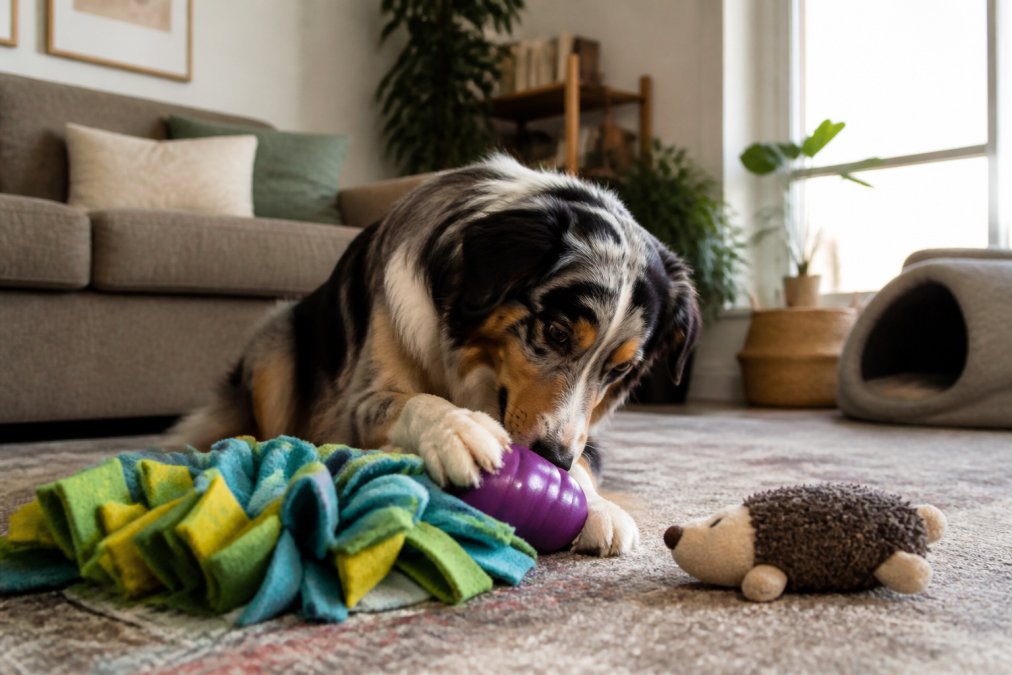
The best calming toys fall into four categories: treat-dispensing puzzles, durable chews, snuffle mats, and plush comfort items. Each targets a different part of the anxiety response, and most anxious pets do best with one from two or three categories rather than a single favourite.
Treat-Dispensing and Puzzle Toys
Treat-dispensing toys turn a snack into a task: the dog rolls, nudges, or paws the toy to release kibble, and that problem-solving loop holds attention.
Durable Chew Toys and Snuffle Mats
Durable chew toys and snuffle mats cover the two most primitive calming behaviours: chewing and scent exploration.
| Toy Type | Best For | Typical Session | Watch Out For |
|---|---|---|---|
| Treat-dispensing puzzle | Departure-time anxiety, fast eaters | 5-20 minutes | Too-hard levels cause frustration |
| Durable chew | Strong chewers, oral soothing | 10-30 minutes | Size up to prevent choking |
| Snuffle mat | Scent-driven dogs, senior pets | 10-15 minutes | Machine-wash regularly |
| Plush comfort toy | Mild anxiety, bedtime settling | Ongoing | Not for heavy chewers |
Separation Anxiety in Dogs: How Calming Toys Help
Separation anxiety in dogs is distress triggered by being left alone, and calming toys help by giving the dog a job during the first, hardest minutes after you leave. That window matters more than the hours that follow.
- Freeze the toy the night before so it lasts longer
- Keep two or three in rotation so novelty does not wear off
- Never take the toy away when you return
- Pair it with a calm, boring exit, no long goodbyes
How to Calm an Anxious Dog: Pairing Toys With Training
Knowing how to calm an anxious dog comes down to pairing the right toy with a consistent training routine: toys manage the moment, training changes the pattern. Most guides treat toys as a distraction instead of a deliberate tool inside a desensitization protocol.
Where the toy fits in a desensitization plan
Desensitization means exposing the dog to the trigger at a level it can handle, then gradually raising that level; counter-conditioning means pairing the trigger with something the dog already loves. A high-value food toy is one of the cleanest counter-conditioning tools available: slow, rewarding, and it keeps the dog's mouth and nose busy while the trigger is present.
A common pattern practitioners use looks like this:
- Identify the trigger at its lowest intensity. For separation anxiety, that might be you picking up your keys. For noise phobia, it might be a recording of thunder at very low volume.
- Present the trigger below threshold. The dog should notice it but not react. If the dog paces, whines, or freezes, the intensity is too high.
- Pair the trigger with the food toy. Put the frozen stuffed toy or puzzle down at the same moment the trigger appears. The dog learns: trigger predicts good thing.
- End on a calm note. Remove the trigger while the dog is still working the toy. Do not wait for the dog to finish and then escalate.
- Repeat, then raise intensity in small steps. Longer absences, louder thunder, closer proximity. Each step only moves forward when the previous one produces no anxious response.
A daily routine that supports the protocol
Protocol sessions are short. The rest of the day still needs structure:
- Anchor the day with a sniff walk. Fifteen minutes of sniffing does more for anxiety than thirty minutes of brisk walking.
- Feed at least one meal from a puzzle or snuffle mat. This replaces a five-minute bowl with a fifteen-minute job.
- Use a chew at departure time. Same toy, same moment, every time.
- Reward calm, not just compliance. Mark and treat the dog for lying quietly, not only for sitting on command.
- Add a comfort bed to the routine. A protected, enclosed space gives the dog somewhere to retreat to when the toy is finished.
Matching the toy to the training stage
Different stages call for different toys. Early sessions need something easy enough that the dog succeeds immediately, so a low-difficulty puzzle or soft chew beats a hard rubber challenge. As confidence grows, raise the difficulty, since a harder puzzle holds attention longer during longer trigger exposures.
SNUGGLES Cove Pet Bed Benefits for Anxious Pets
- Reinforced plush hood that stays open. The enclosed feeling lasts, not just for the first month.
- Removable, washable covers. Anxiety often comes with shedding, drooling, or accidents. You can pull the cover off and machine wash it without a two-person wrestling match.
- Adapts to multiple sleeping positions. Curlers, sprawlers, and stretchers all get a usable shape.
- Spacious XXL size. Large breeds and senior dogs with joint discomfort get real room to stretch.
- Fifth-generation design. Five years of customer feedback shaped the current version.
For dogs that destroy everything, the PUPSICLE is our reusable enrichment toy built for long-lasting frozen treats. It pairs naturally with the bed: chew, settle, sleep.
Safety, Cleaning and Choosing the Right Toy
Safety and hygiene decide whether a calming toy helps or quietly causes a new problem. The right toy depends on jaw strength, size, age, and unsupervised behaviour, and age and noise sensitivity change the recommendation more than breed size does.
Safety checklist before you buy:
- Toy is larger than the dog's throat
- Material matches chew intensity, not just breed size
- No loose parts, squeakers, or glued seams
- Non-toxic materials confirmed by the maker
- Supervised play for the first week with any new toy
- Retire the toy at the first sign of cracking or tearing
Cleaning and hygiene protocols:
- Rinse rubber and puzzle toys after every food use to prevent bacterial growth
- Machine wash snuffle mats weekly, or more often in multi-pet homes
- Hand wash plush toys in warm water and air dry fully before returning them
- Check the inside of puzzle toys for trapped kibble every few days
- Replace chews once they develop deep gouges
Age-specific toy selection
Puppies and seniors have different needs, and one toy rarely suits both.
Noise-sensitive dogs and storm or firework phobias
If your dog flinches at the doorbell, skip the squeaky toy entirely: a squeaker can trigger the exact startle response you are trying to reduce, and the sound is sharper than owners realize.
Conclusion: Building a Calming Routine That Lasts
Anxiety relief toys only work as part of a routine, not a one-off purchase. The dogs that improve are those whose owners pair a chew, a puzzle, and a predictable safe space with consistent, patient training.
Frequently Asked Questions
Do anxiety toys actually work for dogs?
Anxiety relief toys work by redirecting nervous energy into licking, chewing or problem-solving, which releases calming hormones and lowers stress. They work best as part of a wider routine that includes exercise, predictable schedules and a safe resting spot. A dog that is panicking during a thunderstorm may ignore a puzzle toy entirely, so match the toy to your pet's stress level and temperament. For mild to moderate anxiety, treat-dispensing toys and snuffle mats give the biggest benefit because they occupy both mind and body.
What should I look for in a calming toy for my pet?
Look for non-toxic materials, durable construction and a difficulty level that suits your pet. Heavy-duty rubber suits strong chewers, while softer plush or fabric toys suit gentle cats and seniors. Snuffle mats and puzzle toys need to be washable, especially if you use treats or frozen fillings. Avoid toys with small detachable parts that could be swallowed during unsupervised play. Match the toy's chew intensity rating to your pet, and rotate toys every few days so they stay interesting rather than becoming background clutter.
How do I calm my dog's anxiety when I leave?
Build a departure routine that your dog can predict. Give a long-lasting frozen treat toy 15 to 20 minutes before you leave so your dog associates your exit with something good. Keep goodbyes low-key, and practise short absences that gradually get longer. Pair this with a secure, enclosed sleeping space such as a hooded bed, which gives your dog a protected area to retreat to. Calming pheromone diffusers and white noise can support the routine, but the toy and the safe space do most of the work.
Are calming toys safe for unsupervised play?
Some are, some are not. Heavy-duty rubber chew toys and treat-dispensing toys designed for solo use are generally safe to leave with your dog, provided the size is right and there are no loose parts. Rope toys, plush toys with squeakers and snuffle mats should only be used while you are watching, because a determined chewer can shred them and swallow pieces. Check toys for cracks or tears after every session, and replace anything that is breaking down.
