
Calming Beds vs White Noise for Dog Anxiety

Table of Contents
- Calming Beds vs White Noise for Dog Anxiety: How They Differ
- Comparison Table: Calming Beds vs White Noise
- How to Choose Based on Your Dog's Anxiety Trigger
- The Best Calming Bed for Separation Anxiety
- How to Use White Noise for Dogs Safely
- Pet Anxiety Relief Toys That Work With Beds and Sound
- When Home Aids Are Not Enough
- Conclusion
- Frequently Asked Questions
Last Updated: October 7, 2026
Calming Beds vs White Noise for Dog Anxiety: How They Differ
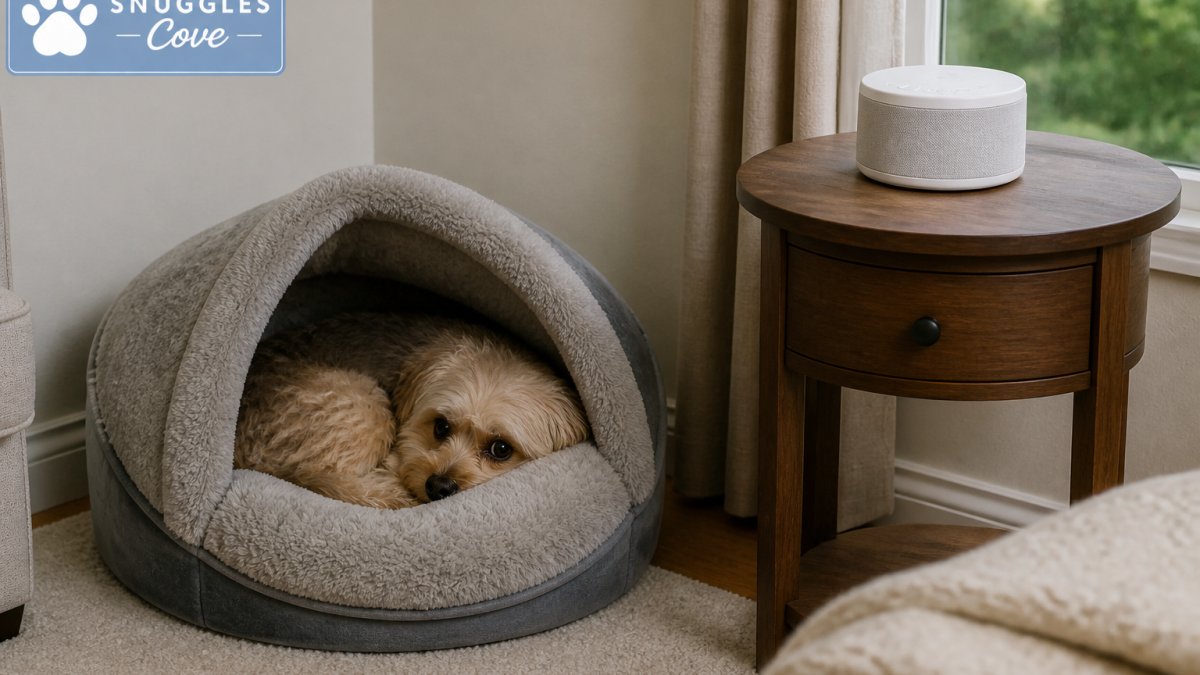
Calming beds vs white noise for dog anxiety is a choice between two different jobs: one changes how a dog feels, the other changes what a dog hears. A calming bed gives an anxious dog a physical place to hide, curl up and feel protected.

What a Calming Bed Actually Does
A calming bed is an enclosed or hooded sleeping space designed to reduce a dog's exposure to the room around it. Many anxious dogs feel safer in a den-like, covered spot than in an open one. A calming bed with a raised rim, a sunken middle or a plush hood gives a dog somewhere to burrow, curl up and block out the visual bustle of a busy home.
What White Noise Actually Does
White noise is a steady, consistent background sound that covers up sudden noises. A dog with noise anxiety reacts to unpredictable triggers: a clap of thunder, a firework, a delivery van. Constant sound at a low level makes those sharp sounds less distinct, so they are less likely to jolt a resting dog awake. White noise does not calm a dog directly, it removes a source of stress.
Comparison Table: Calming Beds vs White Noise
Neither option is universally better. The right pick depends on what sets your dog off.
| Feature | Calming Bed | White Noise |
|---|---|---|
| Primary job | Creates a safe, enclosed resting place | Masks sudden, startling sounds |
| Best for | Separation anxiety, general nervousness | Noise anxiety, storms, fireworks |
| How it works | Physical security and warmth | Steady background sound |
| Works when you're out | Yes, if the dog uses it | Yes, if left running safely |
| Setup effort | Low, once placed correctly | Low, but needs volume tuning |
| Ongoing cost | One-off purchase | Device or app, sometimes free |
| Main limitation | Does nothing for loud sounds | Does nothing for feeling exposed |
| Pairs well with | Sound masking | An enclosed bed |
Beds win on the emotional side, sound wins on the sensory side. Most anxious dogs benefit from at least one, and many do best with both.
How to Choose Based on Your Dog's Anxiety Trigger
Start with the trigger, not the product. White noise changes the input (what the dog hears), while a calming bed changes the context (where the dog rests and how exposed they feel). If the input is the problem, sound masking comes first. If the context is the problem, the bed comes first. If both, layer them.
Match the tool to the trigger pattern
- Noise-triggered fear (storms, fireworks, loud bangs, vacuum). The trigger is sudden and external. White noise or another steady masking sound is the logical first step because it reduces how sharply those sounds cut through. A bed helps afterward, giving the dog a place to recover.
- Separation-related distress (pacing, whining, door-scratching when alone). The trigger is being left, not a sound. An enclosed bed is the better starting point because it gives the dog a predictable, den-like spot that does not depend on you being present. White noise can support this by smoothing out household sounds that keep the dog alert.
- General nervousness or senior restlessness. There is often no single trigger. Try the bed first, because a secure resting place is low-risk and easy to leave in place all day. Add sound masking if the dog still startles at ordinary household noises.
When the trigger is unclear
Many owners cannot name a single trigger, and that is normal. A common pattern is a dog who is fine when you are home but restless when you are out. Run a short experiment rather than guessing:
- Week 1, bed only. Place an enclosed bed in a quiet corner away from doors and windows. Do not add sound yet. Note how long it takes the dog to settle, whether they choose the bed on their own, and whether they stay there.
- Week 2, sound only. Remove the bed from the equation (or leave it but do not encourage it) and run steady, low-level background sound during the times the dog is usually most anxious. Note the same things.
- Week 3, both together. Put the bed back and run the sound at the same time. Compare settling time, sleep duration, pacing, and reactions to known triggers.
This is not a clinical trial. It is a way to stop guessing and start noticing, one week of structured observation tells most owners more than a month of impulse buying.
What the evidence actually supports
It is worth being honest about what is known and what is anecdotal. Enclosed, den-like beds are widely recommended by behaviour-focused organisations because they align with how many dogs naturally seek out covered, sheltered spots, but the evidence is largely observational. White noise and similar masking sounds are also commonly recommended for noise-sensitive dogs, and the mechanism (reducing the sharpness of sudden sounds) is well understood, but individual responses vary.
- Noise-triggered (storms, fireworks, loud bangs): start with sound masking
- Separation-related (pacing, whining when alone): start with an enclosed bed
- General nervousness or senior restlessness: try both, bed first
The Best Calming Bed for Separation Anxiety
For separation anxiety, the best calming bed is one your dog can burrow into, with a hood or rim that holds its shape. This is where cheap cave beds fall short: the hood collapses, the sides flatten, and the den disappears within weeks.
A few things matter more than colour or size when you are choosing:
🐾 WooF - Pet Sofa "Premium Plush" Bed →
- A hood that holds its shape. A collapsing cave defeats the purpose.
- A sunken, cushioned middle. Supports curling up and burrowing.
- Removable, washable covers. Anxious dogs shed, drool and sometimes have accidents.
For a senior dog with stiff joints, a supportive plush bed with an orthopaedic base makes settling easier on the body as well as the nerves. You can see our full range in the RSPCA Australia's advice on creating a safe space for pets and match the bed to how your dog actually sleeps.
How to Use White Noise for Dogs Safely
White noise for dogs works when it is steady, low, and used consistently, not when it is cranked up loud. The goal is to blur sudden sounds, not fill the room. Keep the volume low enough that you can hold a normal conversation over it without raising your voice.
Practical setup: level, distance, duration, and sound type
- Level. Start low and raise it only if your dog still reacts to the trigger. Stand where your dog sleeps and speak in a normal voice: if you can hear yourself clearly over the sound, the level is reasonable. If not, turn it down.
- Distance. Place the source a few metres from your dog's bed rather than right next to their ear. Sound that is too close can be startling in itself. A corner of the room, or a shelf across from the bed, beats a nightstand beside it.
- Duration. Run it during the trigger, not just at bedtime. For storm and firework anxiety, start the sound before the event begins, not after the dog is already pacing. For separation distress, run it while you are out so the dog is not left in silence that makes every outside sound stand out.
How to tell whether it is helping, or making things worse
A sound that calms one dog can unsettle another, especially if it is too loud, too close, or too unfamiliar. Watch for these signals over the first few sessions:
- Signs it is helping: the dog settles faster than usual, sleeps longer, stops pacing, or reacts less sharply to the trigger sound.
- Signs it is not helping: the dog avoids the area near the sound source, pants, paces, stares at the device, or seems more alert than before.
- Signs it is making things worse: the dog tries to leave the room, hides in an unusual spot, trembles, or shows the same distress as before but with added restlessness.
If you see the second or third pattern, turn the sound down, move it further away, or try a different sound type before giving up on masking. If nothing changes after a couple of weeks, the trigger is likely stronger than sound masking alone can handle, time to talk to a vet.
Safety and common mistakes
- Never leave a device where a bored or anxious dog can chew the cord. This is the most common safety risk with sound machines and fans.
- Do not rely on the sound to cover the trigger completely. Masking reduces sharpness; it does not eliminate the sound. A dog with severe noise phobia may still react.
- Do not change the setup every day. Consistency teaches the dog to associate the sound with calm. Pick a level, distance, and sound type, and stick with them for at least a week before adjusting.
Pet Anxiety Relief Toys That Work With Beds and Sound
Pet anxiety relief toys give an anxious dog something to do, and a busy dog is a calmer dog. Licking and chewing are naturally soothing, so a licking mat smeared with something tasty, or a long-lasting frozen treat, can settle a dog in a way a bed or sound machine cannot. The best setup combines all three: a safe enclosed bed, steady background sound, and a calming toy to redirect nervous energy.
When Home Aids Are Not Enough
Home aids have limits. If your dog is injuring themselves, refusing to eat, panting heavily for hours or showing distress that does not ease, no bed or sound machine will fix it. That is a job for veterinary advice. A vet can rule out pain or a medical cause and discuss options, including prescribed medication for severe cases. Home tools are a first line, not a replacement for professional care.
Conclusion
Every anxious dog is different, and finding the right combination takes patience. The good news is that the two tools work on different problems, so you rarely have to choose between them. SNUGGLES Cove builds beds for exactly this moment: a reinforced plush hood that stays open, removable and washable covers, and a refined design shaped by five years of customer feedback. Pair one with steady background sound and a PUPSICLE for enrichment, and you give your dog a genuine place to feel safe.
Frequently Asked Questions
Do calming beds for dogs really work?
Calming beds work by giving dogs a sense of security. Designs with raised sides or a hood let dogs burrow and curl up, which many anxious dogs find soothing. The effect depends on your dog's trigger: a bed helps most with general anxiety and separation anxiety, but less with noise phobias. Look for a bed with a hood that stays open, like the SNUGGLES Cove, so your dog can nest without the sides collapsing.
Can white noise help a dog with separation anxiety?
White noise can help by masking outside sounds that trigger anxiety, such as traffic, neighbours, or hallway noise. It works best as part of a routine: set it up before you leave, keep the volume low, and pair it with a consistent resting place. For separation anxiety specifically, combine sound masking with a calming bed and enrichment toys so your dog has both a safe space and something to do.
What noise is best for anxious dogs?
White, pink, and brown noise are the most common choices. White noise covers the full range of frequencies and masks sharp sounds well. Pink and brown noise have deeper tones that some dogs find less harsh. There is no single best option for every dog, so try one for a week at low volume and watch whether your dog settles faster. Avoid loud or sudden sounds, and never leave a sound machine where your dog can chew the cord.
What do vets recommend for calming dogs with anxiety?
Vets typically start with behaviour and environment changes: a quiet resting place, predictable routines, sound masking, and enrichment. If those are not enough, a vet may suggest calming supplements, pheromone products, or prescribed medication for severe cases. Always speak to your vet before giving any supplement or medication. Home aids like calming beds and white noise can support a vet's plan, but they are not a substitute for professional advice.
